01
More complete files
What is missing is requested from the buyer before the file reaches you. You start at the assessment.
How the file gets complete →The expensive part of an application is not the decision, it is everything before it: missing pieces, figures to look up, checks somebody else already ran. Adefin delivers the file in the state you want to receive it, with the reasoning attached.
From first request to a financeable file, on your side of the table.
What is missing is requested from the buyer before the file reaches you. You start at the assessment.
How the file gets complete →Annual accounts, ratios, legal situation and the integrity check, each with its source and the time it was queried.
Which checks run →The lookups your analyst does by hand today, the AI credit officer has already done, with the source beside every finding.
See it in the application →Every step, every source and the version of the score model that produced the score are recorded.
What you can show afterwards →Every application passes the same set of checks, with the moment of the query attached. You do not get somebody else's summary, you get the source.
Findings from the integrity check and from the research are never scored automatically. They stay open for your judgement, with the reference attached.
A platform that adopts your policy instead of averaging it away.
Factors on or off, each with its own weight and its own translation from value to strength. Knock-outs are yours to set.
Your model sits next to the standard one, so you can compare what a different weighting would do to your portfolio.
Terms, residual values per term, first increased instalment and the price windows you want to work in. Outside them you simply do not appear in the offers.
Your team sees the files you appear in, with the full reasoning. No export to a spreadsheet, no mail thread to request a document.
A file passes through several hands: the seller, the buyer, their accountant, your analyst. Today that runs over mail and phone calls, and everything stops the moment one document is missing.
On app.adefin.be/my everyone works the same file. Whoever is missing a document asks for it there, whoever has it uploads it there. The buyer can give their accountant access for the annual accounts without that accountant ever entering your systems. Whoever joins identifies with itsme, so you know who supplied what.
And everything that happens is logged: who asked for what, who supplied what, at what moment, with the document's fingerprint alongside. A question that left by mail no longer exists afterwards. A question that left from here stays on the file.
A credit decision has to be explainable years later, to your credit committee, your auditor or a regulator. So each of these is fixed at the moment itself, not reconstructed later.
Which source, which answer, which moment. A decision stays traceable to what was known at the time.
Every score points at the version that produced it. Change the weights and older scores stay explainable.
Who changed which parameter and when, with the previous value beside it.
Findings from the integrity check and from the research are never scored automatically. Who assessed, when and with what conclusion is on the file.
From first query to delivery: every status change as a separate event with time and actor.
Every supplied and signed document carries a fingerprint, so the signed version is settled.
Your people see your files. Another financing partner does not see yours, not even inside the same file.
Set per data type, with deletion or anonymisation when the term runs out.
Every machine call logged with key, source and time. Useful for your own control over who requested what.
Processing agreement, hosting inside the European Union and transfers outside the EEA under the standard contractual clauses. What we process for you and for how long is in the contract, not only in a setting.
You do not have to replace anything. Adefin delivers the file into your own systems instead of expecting your people to work in one more screen.
Pull when it suits you or be pushed the moment something changes: both work. Every notification is signed with HMAC, so your system knows it came from us and was not altered on the way.
POST https://your-system.be/adefin/hook
X-Adefin-Signature: sha256=…   (HMAC over time.body)

{
  "event":  "application.scored",
  "ref":    "APP-7F2K",
  "score":  { "value": 72, "tier": "B", "model": "your-model v3" },
  "checks": { "vat": "valid", "sanctions": "clear" },
  "at":     "2026-10-05T09:12:41Z"
}
Your supplier file asks for these, and rightly so: we process identity documents, income data and credit decisions on your behalf.
Information security. The management system around access, retention and incidents for everything we process about your customers.
Privacy information management, as an extension of 27001. It lines up with what you must be able to demonstrate as controller.
AI management system. Governance over the score model and the AI credit officer: who trains, who evaluates, who decides and how human oversight is secured.
Operational controls over a period, independently tested. Usually the report your auditor asks for.
On top of that come the frameworks this product falls under anyway: the GDPR, the EU AI Act (creditworthiness assessment of individuals is a high-risk use there, with requirements on transparency and human oversight), DORA (you are a financial entity, we are an ICT provider, so your third-party risk obligations carry into our contract) and eIDAS for qualified electronic signatures.
Sellers place our financing components on their own listings: a monthly payment on every asset, a simulator, or the full application. That is where the buyer decides, so that is where your offer has to be.
If the buyer enters a VAT number, the amount shown is computed on that profile straight away. So you do not receive applications built on a brochure rate that turns out not to hold.
What the seller displays also stays within the lines: the disclosures that have to accompany a quoted monthly payment are placed and maintained by the component itself, so advertising at the point of sale does not become exposure at yours.
Nothing changes in how you work. The same file, the same checks, the same audit trail, whether it arrives through a component, through the portal or through the seller's API.
On the left the file as your analyst receives it, on the right what still stands years later. Screenshots from the product. Names, numbers and amounts have been replaced.
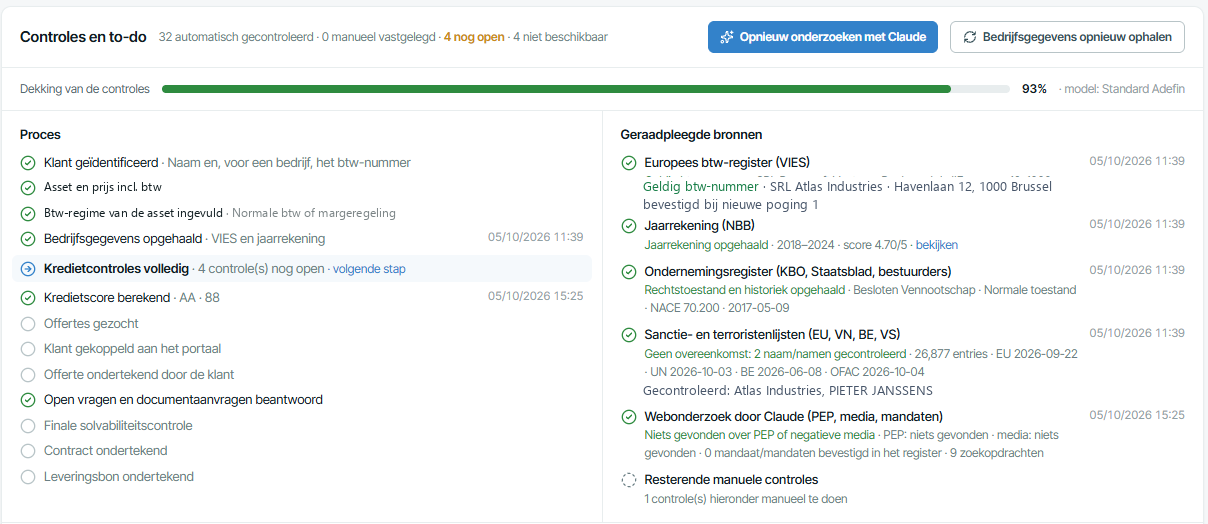
Every check with its source and the time it was queried, and what is still open.
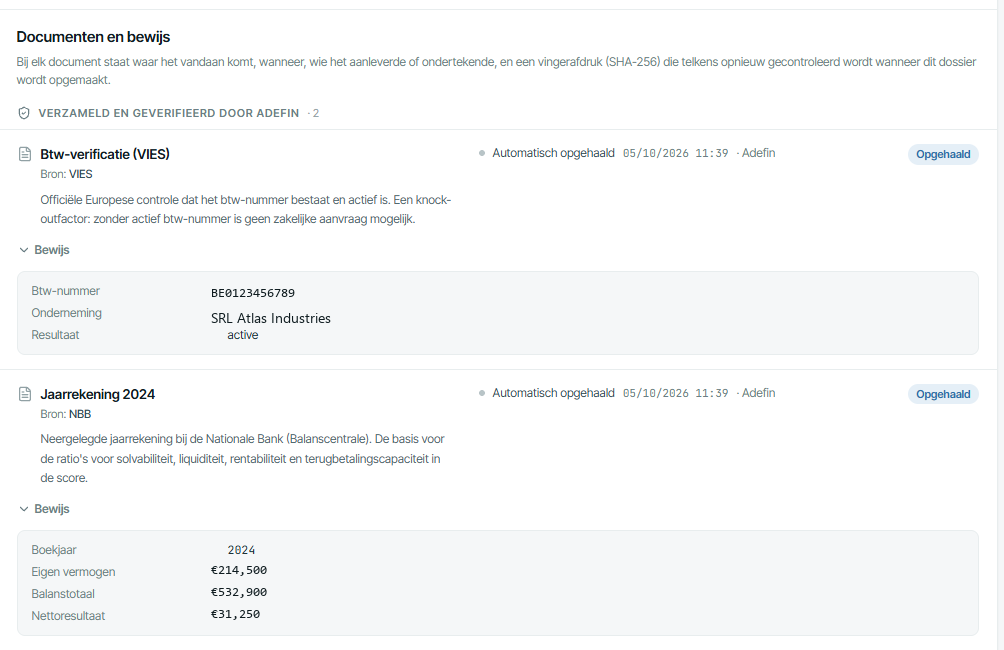
The audit file: every document with its origin and fingerprint, every step with its time and actor.
Your score model, your rate cards and your decisions stay yours. Another partner does not see them, not even in a file you both appear in.
For the personal data in the file we are a processor: with a processing agreement, hosting inside the European Union and retention periods per type of data. What we process for you, and for how long, is in the contract.
Yes. Factors on or off, each with its own weight and its own translation from value to strength, and knock-outs you set yourself. Your model sits next to the standard one, so you can compare what a different weighting would do to your portfolio.
No. Your files and your decisions are not used to train models, and certainly not for another partner. The score model does not learn by itself either: weights change only when someone changes them, and every change is logged.
Always. Adefin builds the file, checks it and puts it in front of you. Approving, declining or setting a condition stays your decision, and so do the rate and the contract.
That is yours to set. Your rate cards and your acceptance rules, terms, residual values, price windows and knock-outs, filter the applications at the gate. What fits inside them reaches you, and which of those files you want stays your call.
Whoever enters the file identifies with itsme. Every document carries who delivered it and when, and every signature is tied to the version that was signed.
Bring your acceptance rules and a rate card. We put your model next to the standard one and show the difference on real files.